Kimi K3 API Guide: Architecture, Benchmarks, Pricing, Limits, and Integration
Explore the Kimi K3 API with a practical guide to Moonshot AI’s 2.8T open-weight model, 1M-token context, architecture, benchmarks, pricing, and production integration.
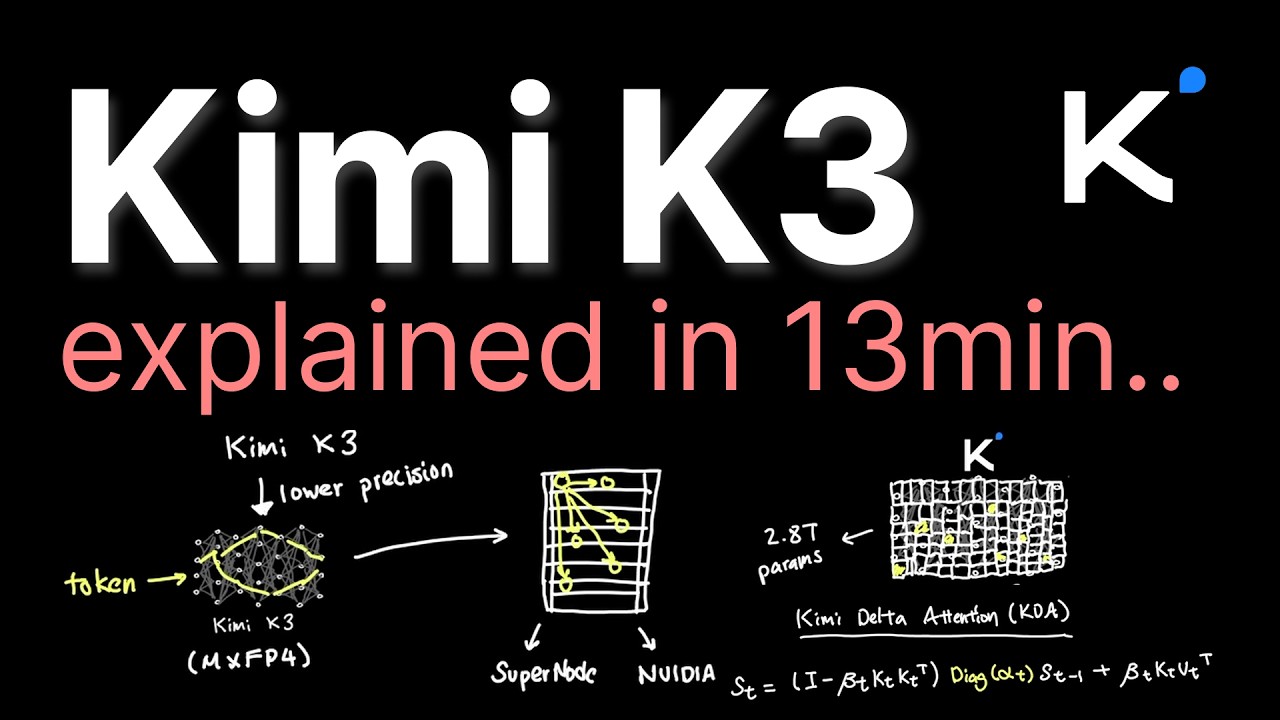
The world of AI is changing fast. The Moonshot AI model is a big step forward. It's a new hybrid architecture, 2.8T paramaters, 69 KDA linear-attention layers interleaved with 24 MLA, LatentMoE, and Attention Residuals; many assumptions in a conventional serving stack may no longer apply.
This model uses Kimi Delta Attention and special residuals. It can handle big data loads that used to slow down systems. With Kimi K3 API integration, you can make systems that work well even when they're under a lot of stress.
This guide is here to help you understand the Moonshot release. You'll learn how to make your system work better with these advanced models. We'll show you how to keep things fast and reliable.

Kimi K3 at a Glance
Kimi K3 is Moonshot AI’s open-weight, native multimodal Mixture-of-Experts model. It contains 2.8 trillion total parameters while activating approximately 104 billion parameters per token. The model supports a 1,048,576-token context window and can process text, images, and video. Through Moonshot’s API, Kimi K3 currently costs $0.30 per million cached input tokens, $3.00 per million uncached input tokens, and $15.00 per million output tokens. Prices were last verified on August 23, 2026.
| Specification | Kimi K3 |
|---|---|
| Total parameters | 2.8 trillion |
| Activated parameters | 104 billion |
| Context window | 1,048,576 tokens |
| Architecture | Sparse Mixture of Experts |
| Modalities | Text, image, and video |
| Model availability | Open weights and hosted API |
| Cached input | $0.30 / 1M tokens |
| Uncached input | $3.00 / 1M tokens |
| Output | $15.00 / 1M tokens |
Sources: Moonshot AI Kimi K3 repository and official Kimi K3 API pricing. Pricing last verified August 23, 2026.
Key Takeaways
- Kimi K3 contains 2.8T total parameters and activates approximately 104B parameters per token through its sparse MoE architecture.
- Kimi Delta Attention improves efficiency for long-context processing in backend environments.
- API users do not need to implement Kimi K3’s internal attention or residual mechanisms, but they should evaluate their practical effects on context accuracy, latency, and cost.
- Engineers can now automate workflows that were previously considered too resource-intensive.
- Strategic deployment of this flagship model significantly enhances your system's overall intelligence capabilities.
What is Kimi K3?
We are entering a new era of open-weight AI. Kimi K3 is leading the way for developers who need top performance. It's not just another model; it's a big change in handling big tasks.
How Does the Kimi K3 Architecture Work?
Kimi K3 combines a sparse Mixture-of-Experts architecture with hybrid attention mechanisms, specialized residual connections, and native low-precision quantization. These components allow the model to draw from 2.8 trillion total parameters without activating the entire model for every token.
The following sections explain what these architectural specifications mean for developers.
2.8T Total Parameters vs. 104B Activated Parameters
Kimi K3 contains approximately 2.8 trillion total parameters. However, it does not activate all 2.8 trillion parameters each time it processes a token.
According to Moonshot AI, Kimi K3 activates approximately 104 billion parameters per token. This distinction is important: 2.8T describes the model’s total capacity, while 104B more closely represents the portion of the model involved in processing each token.
Developers should therefore avoid comparing Kimi K3 directly with a 2.8T dense model. Its computational behavior is determined by its sparse Mixture-of-Experts design.
Stable LatentMoE: 16 of 896 Experts
Kimi K3 contains 896 routed experts and selects 16 of them for each token. It also includes two shared experts that are available across tokens.
Moonshot AI calls this architecture Stable LatentMoE. The routing system directs each token to a small subset of experts based on the information being processed.
This allows Kimi K3 to access a very large pool of specialized parameters without running all 896 experts simultaneously. However, this architecture does not automatically guarantee lower latency. Actual performance still depends on the inference provider, hardware, batching, model settings, and request length.
KDA and Gated MLA
Kimi K3 has 93 layers, consisting of 69 Kimi Delta Attention layers and 24 Gated Multi-Head Latent Attention layers.
Kimi Delta Attention, or KDA, is a linear-attention mechanism designed to process long sequences more efficiently. Gated MLA provides full-attention capacity in selected layers and uses gating to control how information moves through the attention mechanism.
By combining the two approaches, Kimi K3 attempts to balance long-context efficiency with the detailed token-to-token reasoning provided by full attention.
Developers using the hosted API do not need to implement KDA or Gated MLA themselves. Their practical effects should instead be evaluated through context accuracy, latency, throughput, and cost.
Attention Residuals
Transformer models use residual connections to carry information between layers. Kimi K3 introduces Attention Residuals, or AttnRes, to provide more flexible information paths through the model.
Instead of relying only on the output of the immediately preceding attention layer, attention outputs can be stored and combined within a block. Moonshot designed this mechanism to improve information flow across a very deep model.
API users do not need to configure Attention Residuals. The feature is part of Kimi K3’s internal architecture.
Native MXFP4 Quantization
Kimi K3 uses MXFP4 weights and MXFP8 activations. Moonshot AI states that quantization-aware training was applied from the supervised fine-tuning stage onward.
Lower-precision weights can reduce the memory and computation required for inference. However, this does not make Kimi K3 easy to run on ordinary developer hardware. Self-hosting a 2.8T-parameter model still requires substantial distributed infrastructure, compatible inference software, and operational expertise.
Teams that do not want to maintain this infrastructure can instead access Kimi K3 through a hosted API.
How the 1M-Token Context Window Works
Kimi K3 supports a maximum context length of 1,048,576 tokens. This gives developers enough theoretical capacity to submit large documents, extended conversation histories, or substantial portions of a codebase in a single request.
However, a 1M-token context window does not mean that every application should send one million tokens. Larger requests may increase latency and uncached input costs, while irrelevant context can make it harder for the model to identify the most important information.
For production applications, developers should still:
- Remove irrelevant files and duplicated content.
- Place the most important instructions clearly in the prompt.
- Keep repeated prompt prefixes unchanged when using automatic caching.
- Test retrieval accuracy at different context lengths.
- Measure latency and cost before sending an entire repository.
The large context window reduces the need for aggressive chunking, but it does not eliminate the need for careful context management.
Source note: Architecture specifications are based on Moonshot AI’s official Kimi K3 repository and technical report.
Core Use Cases: From Autonomous Coding to Multi-Agent Systems
Moonshot AI presents Kimi K3 as suitable for long-horizon coding, knowledge work, and multimodal workflows. The following examples reflect provider-described capabilities and should be validated against your own production requirements.
- Long-Horizon Coding: Operating with minimal human oversight, Kimi K3 can sustain long engineering sessions, navigate massive repositories, and orchestrate terminal tools. Moonshot highlights potential applications including GPU kernel optimization, end-to-end compiler development, and autonomous chip design.
- End-to-End Knowledge Work: Moonshot presents Kimi K3 as capable of supporting professional knowledge-work tasks Kimi K3 advances professional knowledge work by transforming raw data into bespoke charts, interactive visual narratives, and publication-quality reports.
- Multimodal & Video Editing: Leveraging its native multimodal architecture to understand text, images, and video seamlessly, Moonshot also demonstrates Kimi K3 in multimodal workflows involving motion design, animation, and video editing. Kimi K3 excels at complex motion design, animation, and professional video editing.
Kimi K3 Benchmarks: What Moonshot’s Official Results Show
Moonshot AI reports that Kimi K3 achieves competitive results across coding, reasoning, agentic, and multimodal benchmarks. However, Kimi K3 does not lead every test. Its relative performance varies depending on the task, model configuration, reasoning setting, tool access, and evaluation environment.
The following scores were published by Moonshot AI and should be treated as provider-reported results rather than independent OctopusX testing.
Coding Benchmark Comparison
The table below compares Kimi K3 with Claude Fable 5 and GPT‑5.6 Sol across several coding benchmarks included in Moonshot AI’s official evaluation.
| Coding benchmark | Kimi K3 | Claude Fable 5 | GPT‑5.6 Sol |
|---|---|---|---|
| DeepSWE | 67.5 | 70.0 | 73.0 |
| ProgramBench | 77.8 | 76.8 | 77.6 |
| Terminal-Bench 2.1 | 88.3 | 88.0 | 88.8 |
| FrontierSWE | 81.2 | 86.6 | 71.3 |
| SWE-Marathon | 42.0 | 35.0 | 39.0 |
Kimi K3 produces the highest reported score among these three models on ProgramBench and SWE-Marathon. It also performs competitively on Terminal-Bench 2.1, where its reported score of 88.3 is close to GPT‑5.6 Sol’s 88.8.
However, Kimi K3 does not lead DeepSWE, FrontierSWE in Moonshot’s published results. This makes it more accurate to describe Kimi K3 as competitive across coding benchmarks rather than universally superior to every competing model.
Benchmark source and methodology note: Results are reported by Moonshot AI in its official Kimi K3 evaluation results, accessed August 23, 2026. Model configurations, reasoning settings, tool access, and fallback policies may differ. These results have not been independently reproduced by OctopusX.
DeepSWE Results
In Moonshot AI’s published evaluation, Kimi K3 received a DeepSWE score of 67.5, compared with 70.0 for Claude Fable 5 and 73.0 for GPT‑5.6 Sol.
Based on these reported results, Kimi K3 does not lead this particular benchmark. It nevertheless remains within the same broad performance range as the two compared frontier models.
The official comparison table reports a single DeepSWE score for each model. It does not label these figures as Pass@1 or Pass@k. For that reason, the scores should not be described as first-attempt success rates unless the original benchmark methodology explicitly defines them that way.
Developers should also avoid treating the DeepSWE score as a direct measurement of production reliability. Performance in a private repository may change according to tool access, test coverage, dependency structure, prompt quality, and the amount of relevant context provided.

What These Benchmark Scores Do Not Tell You
Public benchmark scores provide a useful reference, but they do not measure every factor that matters in a production development environment.
These scores do not necessarily tell you:
- How accurately the model understands your private repository
- Whether generated changes pass your existing test suite
- How often the model introduces regressions
- How much manual correction the generated code requires
- How reliably the model uses terminals and other development tools
- How many retries are required
- How long the task takes
- How many tokens are consumed
- How much each accepted solution costs
Benchmark conditions may also differ between models. One model may receive a larger reasoning budget, different tool access, or a fallback mechanism that another model does not receive.
Teams should therefore use public benchmarks as an initial reference, not as the only basis for selecting a production model.
How to Test Kimi K3 on Your Own Codebase
The most reliable way to evaluate Kimi K3 is to test it on representative tasks from your own engineering workflow. Instead of assigning unsupported ratings such as “Excellent” or “Very High” to individual programming languages, build a controlled evaluation using real tasks from your repository.
A practical evaluation can include 20 to 50 tasks covering the languages, frameworks, and development tools your team uses in production.
What Should You Test?
Select tasks that represent the work your developers regularly perform:
- Fixing bugs with reproducible test failures
- Implementing a feature across multiple files
- Refactoring existing code
- Generating or improving unit tests
- Resolving build and dependency errors
- Reviewing code for security or reliability problems
- Creating SQL queries or database migrations
- Using terminal tools to inspect, build, and test a repository
Recommended Evaluation Metrics
| Metric | How to measure it |
|---|---|
| First-pass success | Whether the first submitted solution passes all required tests |
| Build success | Whether the generated change compiles or builds without manual corrections |
| Regression rate | Whether the change breaks previously passing tests |
| Task completion | Whether the requested behavior is fully implemented |
| Human review time | How long an engineer needs to review and correct the result |
| Tool-call success | Whether the model selects the correct tools and supplies valid arguments |
| Latency | Time to first token and total time to completion |
| Token usage | Input, cached-input, reasoning, and output tokens used |
| Cost per accepted task | Total API cost divided by the number of accepted solutions |
Keep the Comparison Fair
Use the same conditions for every model:
- The same task description
- The same repository revision
- The same files and context
- The same tools and permissions
- The same retry limit
- The same timeout
- The same automated tests
- The same human-review criteria
Do not compare one model’s first response with another model’s best result after several retries.
Example Evaluation Plan
For example, your team could evaluate Kimi K3 using 30 representative development tasks: ten Python debugging tasks, ten TypeScript refactoring tasks, and ten SQL generation tasks.
Run the same tasks through each comparison model using identical repository context, tool access, timeout, retry limit, and automated tests. Count a task as successful only when the proposed change satisfies the original requirements and passes all required tests without manual code corrections.
After completing the evaluation, compare the regression rate, human review time, latency, token usage, and cost per accepted solution—not only the number of successful tasks.
Is Kimi K3 Better Than GPT 5.6?
There is no universal winner in the Kimi K3 vs GPT‑5.6 comparison. The better choice depends on the workload, model configuration, tool access, latency requirements, and budget.
Moonshot’s provider-reported results show that Kimi K3 and GPT‑5.6 lead different evaluations. Teams should compare them under the same production conditions rather than infer overall suitability from a single benchmark.
The most reliable way to choose is to run both models on representative internal tasks and compare:
- First‑pass success
- Regression rate
- Human review time
- Tool‑call reliability
- Response latency
- Token usage
- Cost per accepted task
Public benchmarks should be used as an initial reference, not as the only basis for selecting a production model.
Kimi K3 API Pricing
Kimi K3 uses separate rates for cached input, uncached input, and output tokens. Based on the pricing used in this comparison, Kimi K3 costs $0.30 per million cached input tokens, $3.00 per million uncached input tokens, and $15.00 per million output tokens.
This pricing structure can make Kimi K3 cost-effective for coding assistants, document analysis, AI agents, and other applications that repeatedly send the same system prompt or long context. However, the actual cost depends on your input length, output length, request volume, and cache-hit rate.
| Token category | Official Kimi K3 price |
|---|---|
| Cached input | $0.30 / 1M tokens |
| Uncached input | $3.00 / 1M tokens |
| Output | $15.00 / 1M tokens |
Official source: Kimi K3 API Pricing. Prices exclude applicable taxes.

Kimi K3 vs. Kimi K2.7 Code: Price and Workload Differences
| Model | Cached input | Uncached input | Output | Context |
|---|---|---|---|---|
| Kimi K3 | $0.30 | $3.00 | $15.00 | 1,048,576 |
| Kimi K2.7 Code | $0.19 | $0.95 | $4.00 | 262,144 |
Prices were verified against Moonshot’s official documentation on August 23, 2026. Kimi K3 and Kimi K2.7 Code target different workloads, so the lower token price does not by itself determine which model is more cost-effective per successful task.
How to Call Kimi K3 Through an OpenAI-Compatible API
Kimi K3 can be accessed through an OpenAI-compatible API. If your application already uses the OpenAI SDK, you can connect to a compatible Kimi K3 endpoint by updating the API key, base URL, and model identifier.
The examples below use Moonshot AI’s official API configuration. When using OctopusX, replace the base URL and model identifier with the values provided in the OctopusX documentation.
Basic Python Example

Store the API key in an environment variable instead of placing it directly in the source code. The reasoning_effort parameter supports low, high, and max, with max currently used as the default by Moonshot AI.
cURL Example

Kimi K3 streaming responses may contain separate reasoning_content and final-answer content fields. Applications should process these fields separately rather than assuming that all generated text appears in content.
Multi-Turn Conversations
Kimi K3 was trained to preserve thinking history across multiple turns. When sending the next request, return the complete assistant message produced by the previous response.
Do not preserve only the final content. Keep additional fields such as reasoning_content and tool_calls when they are returned by the API.
Tool Calls and Structured Output
Kimi K3 supports tool calls and structured output. When the model returns one or more tool calls, execute each requested tool, return the corresponding result with the correct tool_call_id, and include the complete assistant message in the next request.
For structured data, use a strict JSON Schema and parse the final content field rather than the model’s reasoning output.
See Moonshot AI’s Kimi K3 Quickstart for current request formats and supported API capabilities.
Kimi K3 Limitations and Production Checklist
Kimi K3 provides a large context window and advanced reasoning capabilities, but production integration requires more than sending a basic API request. Developers should account for its thinking behavior, context costs, message-history requirements, input restrictions, and operational reliability.
Thinking Mode Is Always Enabled
Kimi K3 always operates with thinking enabled. Developers can control the amount of reasoning with reasoning_effort, which currently supports low, high, and max.
Higher reasoning settings may improve performance on difficult tasks, but they can also increase response time and token consumption. Test multiple settings against your actual workload instead of using the maximum setting for every request.
Some Request Parameters Are Fixed
Moonshot AI’s current documentation specifies fixed values for parameters including temperature, top_p, n, presence_penalty, and frequency_penalty. Developers should omit unsupported overrides instead of assuming that every OpenAI SDK parameter behaves in the usual way.
Multi-Turn History Must Be Preserved
In multi-turn conversations and tool-calling workflows, return the complete assistant message in the next request. Preserving only the final content may remove reasoning or tool-call information required by the model.
A 1M-Token Context Window Still Requires Context Management
A 1,048,576-token context window does not mean every request should contain one million tokens. Large prompts can increase latency and uncached-input costs, while irrelevant files may make it harder for the model to identify important information.
Remove duplicated or unrelated context, keep frequently reused prefixes stable, and test accuracy at multiple context lengths.
Vision and Web Search Have Current Restrictions
Vision requests must follow Moonshot AI’s supported input format. The current documentation does not support arbitrary public image URLs for Kimi K3 vision input.
Moonshot AI also states that its web-search functionality is being updated and is not recommended for near-term production use. Check the latest documentation before relying on it in a production workflow.
Production Deployment Checklist
- Confirm the correct API base URL and model identifier.
- Keep API keys in environment variables or a secrets manager.
- Preserve complete assistant messages in multi‑turn requests.
- Validate tool names, arguments, and tool_call_id values.
- Set request timeouts and retry limits.
- Run automated tests against generated code.
- Log latency, errors, token usage, and cache‑hit rates.
- Limit maximum output length where appropriate.
- Configure a backup model or provider.
- Monitor cost per successful task rather than token price alone.
- Review Moonshot AI’s documentation when model behavior or pricing changes.
Source: Production limitations are based on Moonshot AI’s Kimi K3 Quickstart. Documentation accessed August 23, 2026.
Don’t Use One Model for Every Task
Using the most capable model for every request is rarely the most economical architecture. Simple extraction, classification, and formatting tasks may not require the same model as complex coding, planning, or long-context reasoning.
A multi-model API gateway can route each request according to task complexity, quality requirements, latency targets, and budget.
| Workload | Suggested routing strategy | Primary objective |
|---|---|---|
| Classification and extraction | Route to a lower-cost model | Minimize cost |
| Coding and repository analysis | Route to Kimi K3 when testing supports it | Balance quality and context handling |
| Complex reasoning | Route to a higher-performing model | Maximize task success |
| Latency-sensitive chat | Choose the fastest qualified model | Reduce response time |
| Provider failure or rate limit | Retry through a backup provider | Improve availability |
A production routing policy might begin with a lower-cost model and escalate only when confidence is low, validation fails, or the task exceeds a defined complexity threshold.
This approach can reduce unnecessary token spending without forcing every request through the same model.
Deploy Kimi K3 with the OctopusX Unified API
You can access and deploy Kimi K3 through OctopusX, a unified API platform for leading AI models. Instead of building and maintaining a separate integration for every model provider, your team can use one API endpoint to test Kimi K3, compare it with other models, and move it into production.
OctopusX provides an OpenAI-compatible API, making it straightforward to integrate Kimi K3 into existing applications. If your application already uses the OpenAI SDK, you can connect to OctopusX by updating the API key, base URL, and model identifier.
With the OctopusX API, developers can:
- Access Kimi K3 and other leading models through one API
- Switch models without rewriting the application
- Centralize API authentication, usage, and billing
- Compare model quality, latency, and token costs
- Route different workloads to the most suitable model
- Configure fallback options to improve application availability
Before deploying Kimi K3 at scale, test it with prompts taken from your real production workload. Compare response quality, time to first token, total latency, output length, failure rate, and cost per successful request. OctopusX makes these comparisons easier because the same API integration can be used across multiple models.
Start Using the Kimi K3 API on OctopusX

Deploy Kimi K3 without creating and maintaining another provider-specific integration.
Already using an OpenAI-compatible SDK? Update your API configuration and start testing Kimi K3 through OctopusX.
FAQs
Before you start using Kimi K3, let's clear up some common questions. High-performance AI needs clear answers, so you can choose the right tools for your needs.
Is Kimi K3 a Chinese Model?
Kimi K3 comes from Moonshot AI in Beijing. It's making waves in the US for its unprecedented performance-to-cost ratio and big context window.
US developers are interested because it challenges Western models. Innovation knows no borders. This model's fast growth is starting a big talk about AI competition worldwide.
Is Kimi K3 Fully Free for Developers?
OctopusX perspective: Production teams should select and route models according to task quality, latency, reliability, and cost rather than parameter count alone.
What Is the Difference Between Kimi K3 and Kimi K2.7 Code?
Kimi K3 offers a larger context window and broader flagship capabilities, while Kimi K2.7 Code has lower published token prices. The more cost-effective model depends on task-success rate, token usage, latency, and required capabilities.
Kimi K3 supports a 1,048,576-token context window, compared with 262,144 tokens for Kimi K2.7 Code. Kimi K3 also provides native multimodal capabilities and is positioned by Moonshot AI for long-horizon coding, reasoning, and agentic knowledge work.
Kimi K2.7 Code may be more economical for coding tasks that do not require Kimi K3’s larger context window or broader capabilities. Teams should compare both models on representative internal tasks before making a production decision.